Contents:
• What are glaciers?
• Where are they found?
• How do glaciers shape the landscape?
• What landforms do they create?
• How do glaciers affect us?
• What if all the glaciers melted?
• Quiz Time!
• Quiz answers
• Answers for activities
• Glossary
• Sources
What are Glaciers?
Glaciers are large masses of ice which slowly flow. They are formed when snow builds up, year after year, and is then compressed into ice. When the glacier is big enough, it starts to flow under its own massive weight.
It is fascinating how different glaciers can greatly differ in size, weight, thickness and the speed they flow at. For example, the fastest moving glacier (Jakobshavn Isbrae in Greenland) moves about 17 km a year, while other glaciers move only 300 m a year!

A large glacier
How do glaciers move?
One of the ways a glacier moves, is when ice at the base of the glacier melts and the glacier then slides on top of the meltwater. Glaciers also move when ice crystals in the glacier slide past each other.
Where do they form?
Most glaciers form high up in the mountains, or at the South and North of the Earth because there it is very cold.
Vital Vocab!
ICE SHEET – A massive glacier which covers a large area.

An ice sheet.
Fun Facts!
About 69% of the world's fresh water is in glaciers!
To make 1 meter of ice, you need about 10 meters of snow.
Activity 01
Ice To Water!
Glaciers make meltwater when they compress ice. Why don't you make some? Take an ice cube and squish it. You'll get some water!
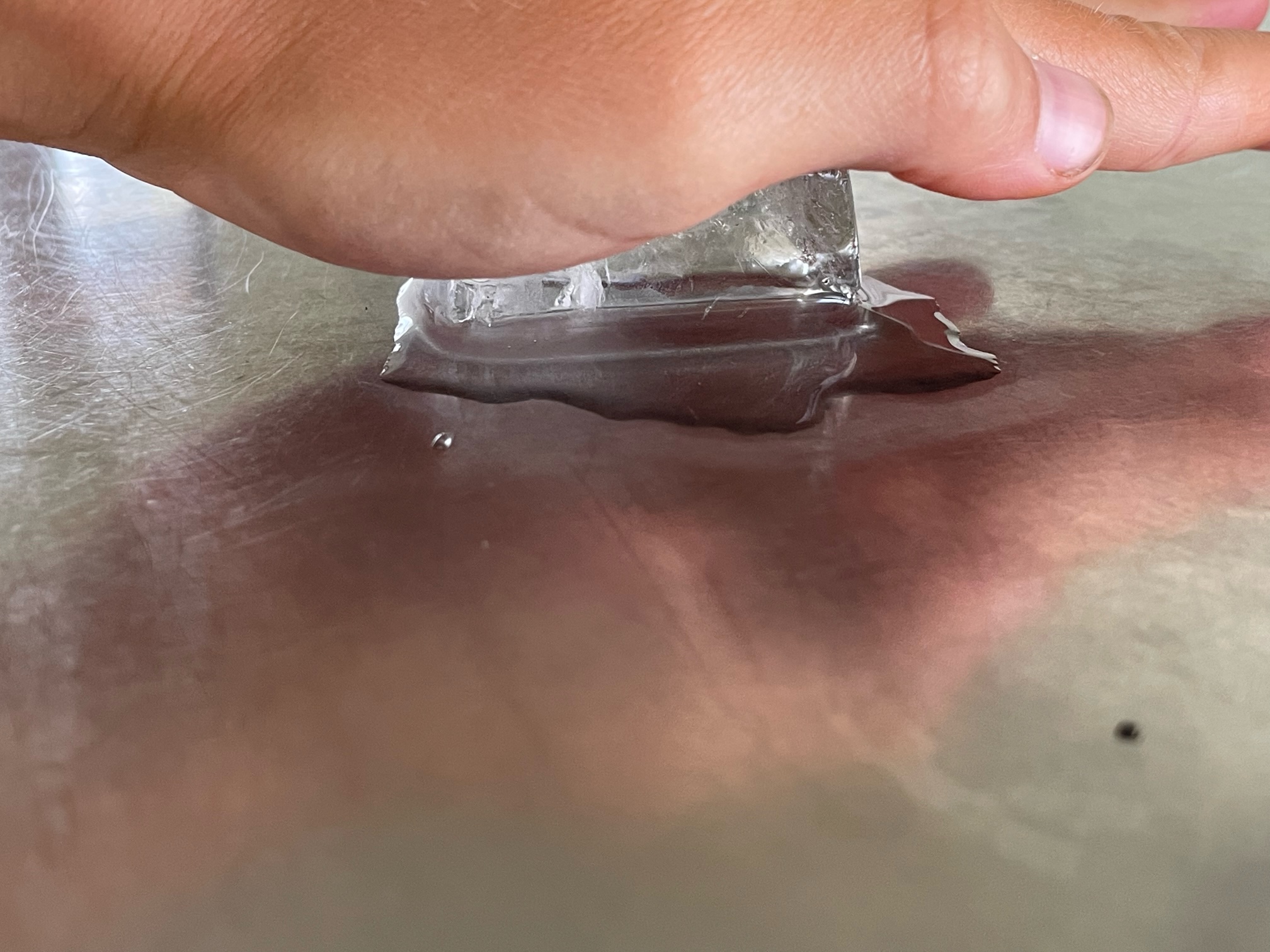
A compressed ice cube.
Snow To Ice – How many meters of snow do you need, to make 100 meters of ice? Hint: look at the FUN FACTS.
Where are they found?
Most glaciers are in Greenland and Antarctica. Let's look at some statistics about the average distribution of glaciers.
91% in Antarctica
8% in Greenland
Less than 0.5% in North America (about 0.1% in Alaska)
0.2% in Asia
Less than 0.1% are in South America, Europe, Africa, New Zealand, and Indonesia.
(These statistics come from www.usgs.gov)

Greenland.
The temperature a glacier needs, to form.
To form, glaciers usually require a temperature of less than 0ºC. This is why Greenland and Antarctica are the perfect home for a glacier. Greenland has an average temperature of -2.6 and Antarctica has an average temperature of -42.2.
Vital Vocab!
ANTARCTICA – A snow covered continent bigger than Australia, which has more than 90% of the world's glaciers!

Antarctica.
Fun Facts!
75% of the world's fresh water is in glaciers!
Activity 02
Find The Words!
Click on the letters to highlight them.
A
P
A
I
C
T
C
X
Y
W
Q
N
X
G
G
R
G
Q
W
T
D
G
T
L
D
S
K
R
D
B
W
B
L
A
B
H
F
E
N
H
F
D
O
C
R
Y
H
T
S
R
U
H
F
I
O
C
A
N
N
U
M
H
D
E
X
A
T
F
O
U
I
P
R
R
G
W
B
I
W
T
C
C
D
O
F
S
N
B
C
W
I
E
E
Z
B
G
I
T
Q
A
Can you find the four cheeky words?
Antarctica
Glacier
Ice
Snow
How do glaciers shape the landscape?
Glaciers are nature's bulldozer – they shape the landscape in many spectacular ways. Let's check them out!
Erosion
Erosion happens in two ways.
1. Plucking – When the glacier ice freezes around rocks, it then pulls at them until they break from the ground. This is called plucking.
2. Abrasion – Abrasion is when plucked rocks of all sizes scrape at other rocks on the base of a glacier.

Frozen rocks.
Transportation
The glacier transports rocks while it flows. It can carry them at the base, middle or surface of the glacier.
Deposition
At the snout (the end of the glacier) the glacier melts into meltwater. This water will usually feed a lake or a river. Meltwater looks milky because of particles called rock flour or glacial flour.
When the glacier melts, it drops all the rocks and debris it carried. This mixture is called glacial till.
Vital Vocab!
Freeze-thaw weathering – This process make plucking easier. When water seeps into cracks in rocks and freezes into ice, it expands and the cracks in the rocks get bigger. This process repeats until the rocks break. Because they are now smaller, they are easier to pluck out.
Fun Facts!
Glaciers are often dirty since all kinds of debris is transported to the top of the glacier.
Activity 03
Vowels!
Add in the missing vowels to form words!
What landforms do glaciers create?
Glaciers create fascinating landscapes through many processes. Some examples include pyramidal peaks and U-shaped valleys.
Corries
Read on to find out how corries are made.
1. – Corries begin as hollows in the ground where snow builds up, year after year.
2. – The snow is compacted into ice and a glacier forms. It erodes the hollow, making it deeper.
3. – When the glacier is big enough, it flows out of the hollow.
4. – When the glacier melts, it will show the corrie it was in. It may fill up with water, forming a lake.
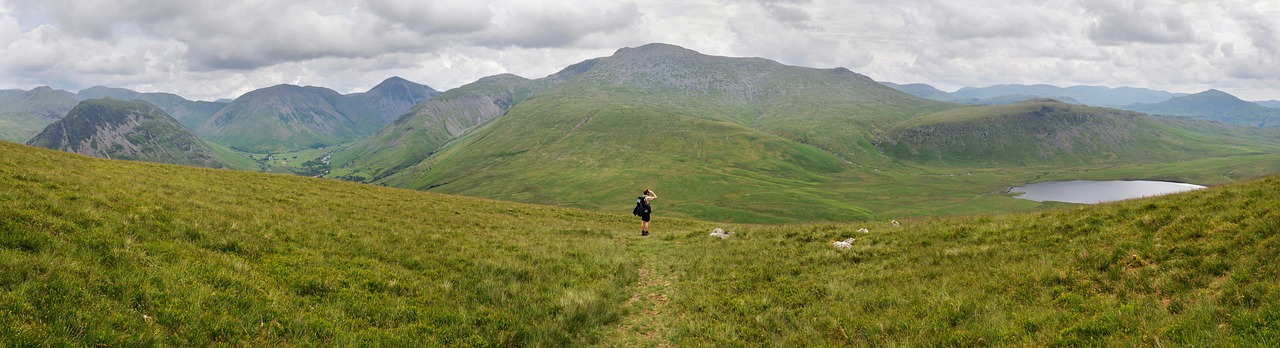
A corrie
Arêtes
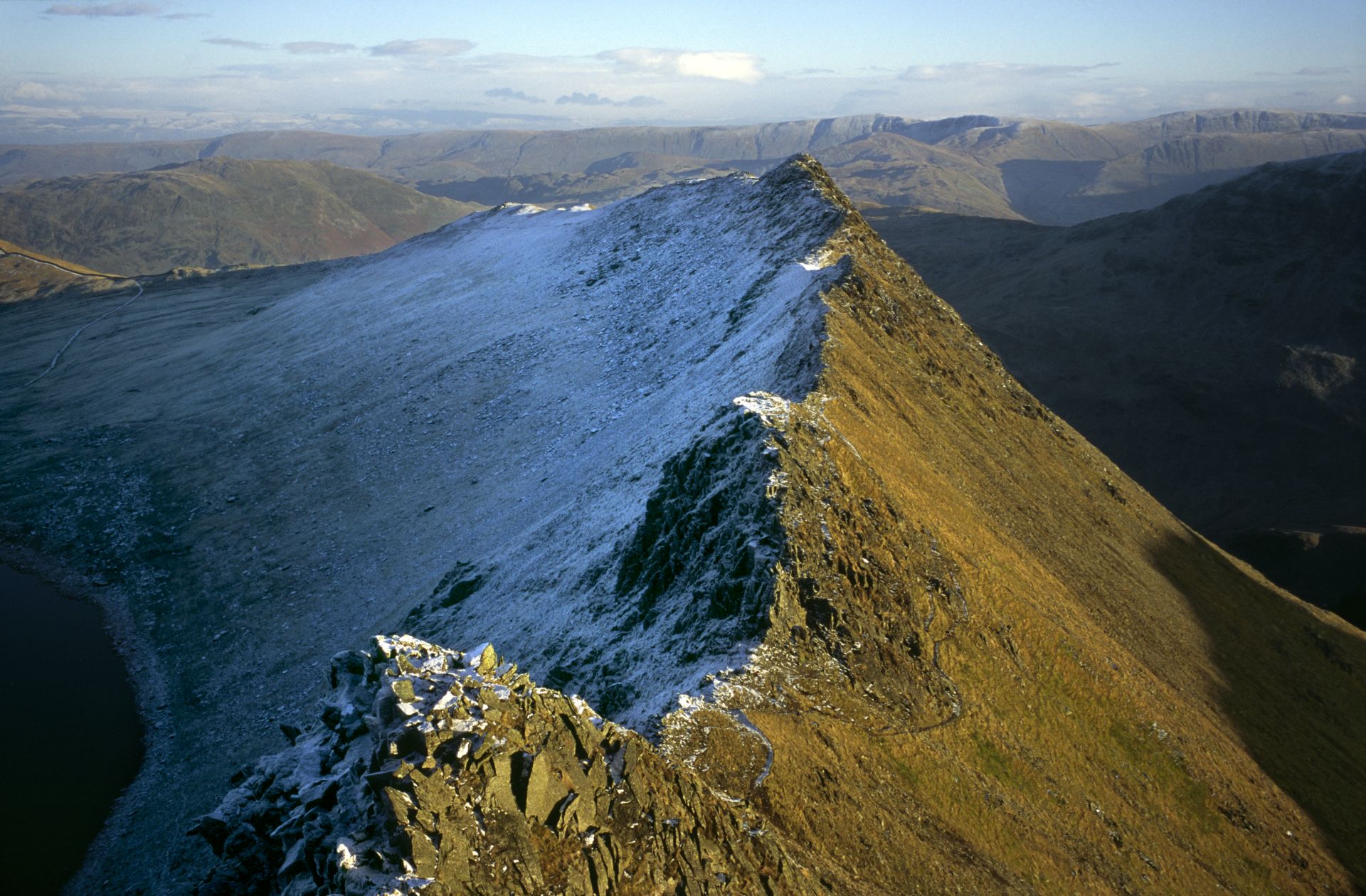
When two corries form side by side, they leave a sharp, narrow ridge called an arête.
Pyramidal Peaks
When four or three corries form side by side around a mountain top they will erode the mountain walls leaving a sharp peak.

The Matterhorn, a famous pyramidal peak.
U-shaped Valleys.
1. – Glaciers take the easiest route while flowing. If a river carves out a V-shaped valley, the glacier might bulldoze its way into it because it is easier to flow there than in some other places.
2. – It will carve out a more deep, U-shaped valley.
3. – When the glacier melts, the valley is revealed. Many times, a small river or stream zigzags its way into the U-shaped valley. It is called a misfit river because it looks tiny compared to the U-shaped valley.

A misfit river
Drumlins
Drumlins are smooth, low and egg-shaped hills. They are clues that a glacier flowed here, but scientists are not really sure how they formed.
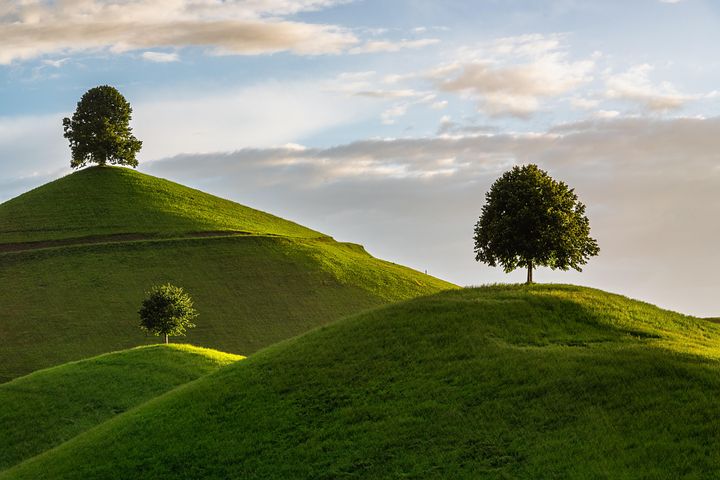
Drumlins
Striations
Striations are long and deep scratches in the rocks which were made by glaciers.
Hanging Valleys
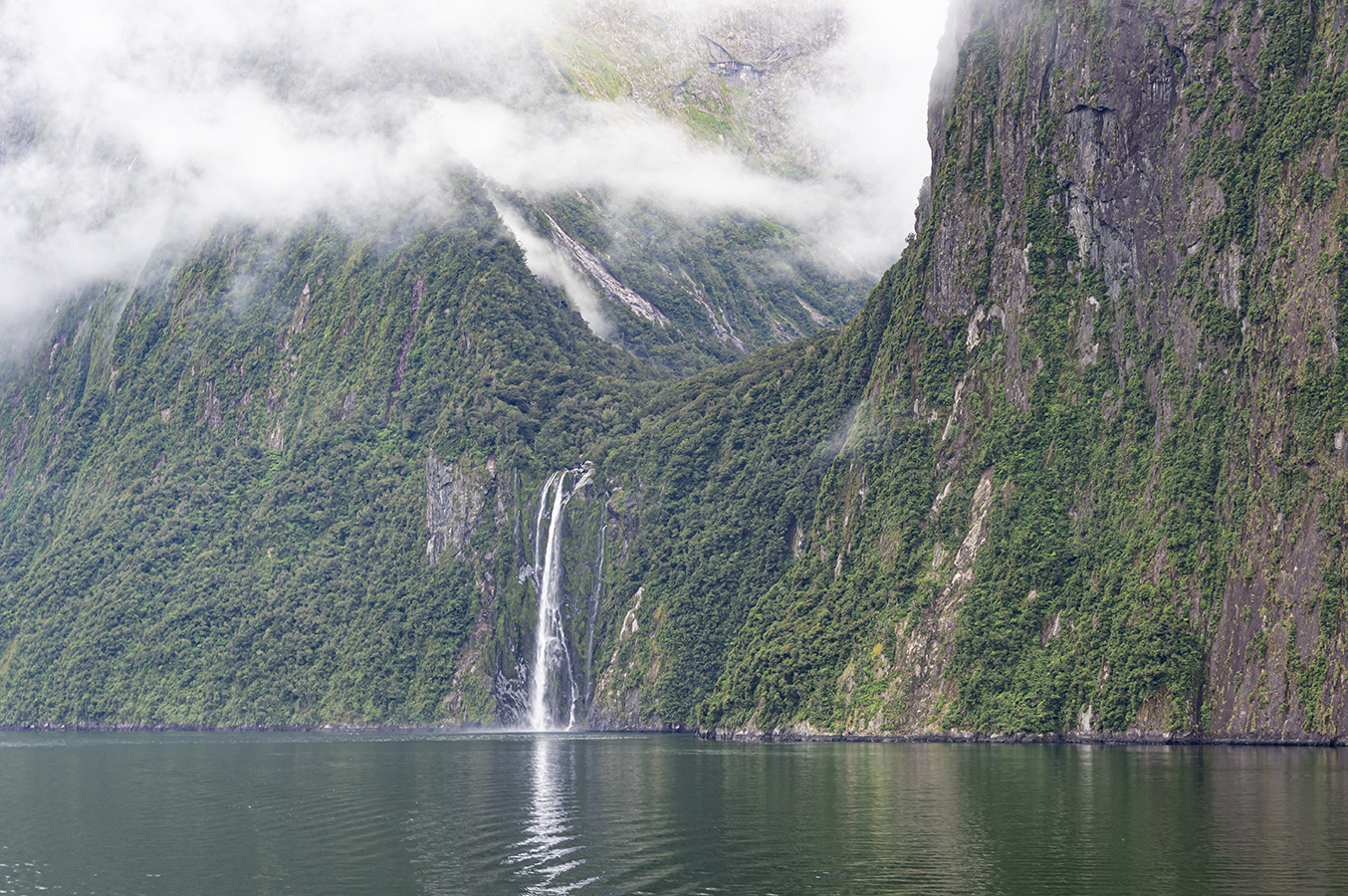
When a small glacier joins a bigger one, and melts, it forms a hanging valley above the bigger U-shaped valley. It might have a river in it, creating a waterfall.
Moraine
Moraine is glacial till deposited by the glacier. There are three types of moraine.
Terminal moraine (end moraine) collects at the snout of the glacier. The glacier drops its load because it melts and over hundreds or even thousands of years, the terminal moraine forms a ridge.
Lateral moraine collects at the sides of the glacier.
Ground moraine is the moraine at the base of the glacier. It is revealed if the glacier melts.
Vital Vocab!
Tarn – Another word for a lake in a corrie.
Fun Facts!
Erratics are clues that a glacier was here. They are named after errors. They look clearly out of place because the glacier carried them very far from their starting place. They are usually big and a different type of rock.
Activity 04
Scrambled!
Can you unscramble the letters to form words?
nameiro
rrocie
ssittraoin
yvlael
How do glaciers affect us?
Glaciers impact us in many ways - let's look at some of them.
Farming
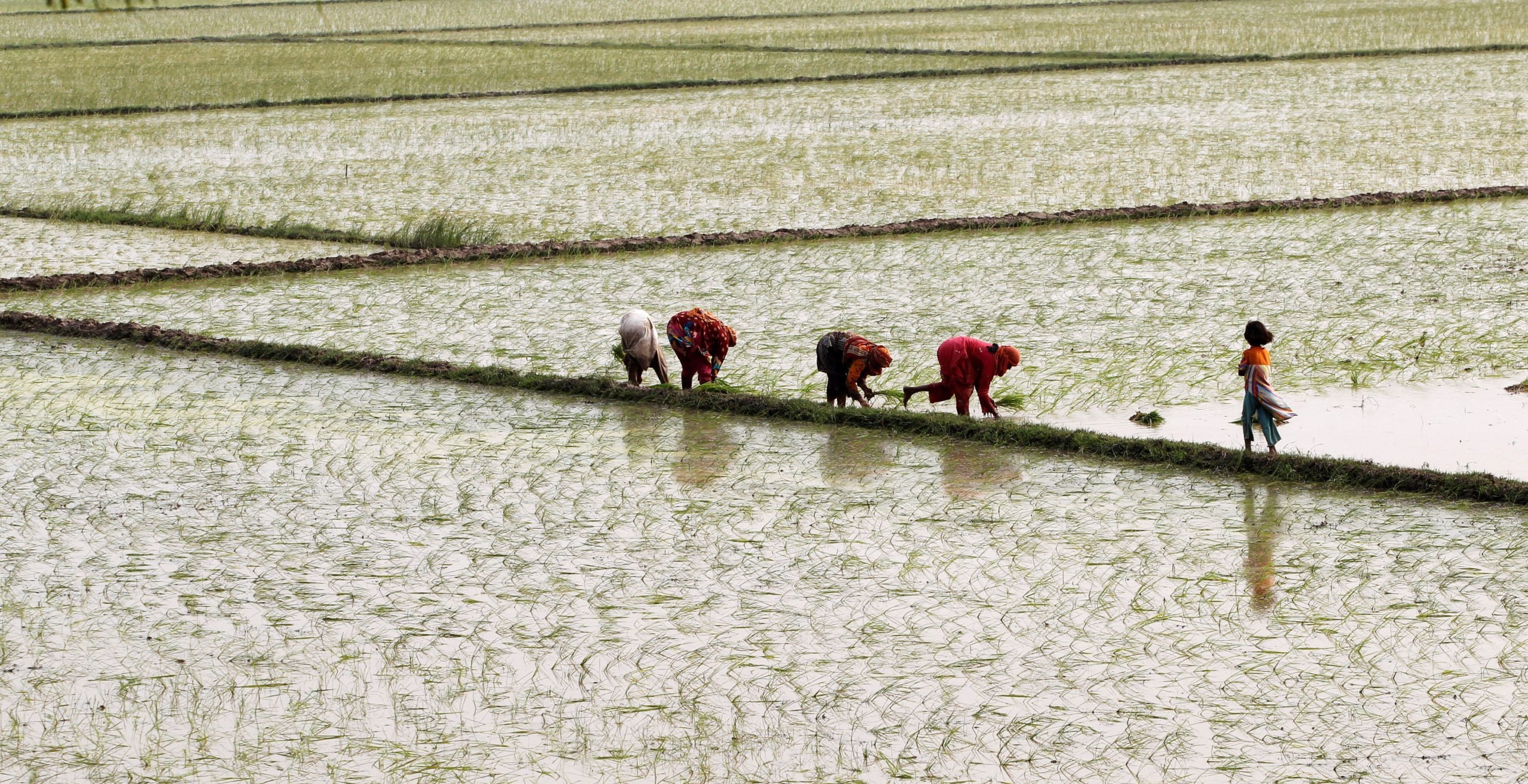
Many farmers depend on glacial meltwater for growing crops. Especially in poorer regions such as Pakistan.
Mt. Everest
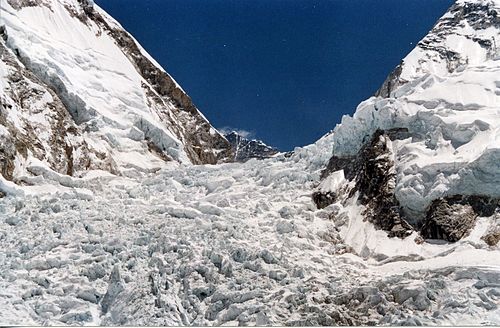
Mount Everest has many challenging glaciers. The climb wouldn't be so exiting or hard without glaciers.
Equipment Companies
Many companies make equipment for tourist, climbers and scientists going to glaciers. They hugely rely on glaciers to stay in business.
Tourists
Lots of companies, small and big, rely on tourists. When tourists visit glaciers, they might have to pay for tours, hotels to stay in and many other things.
Scientists
Many scientists need glaciers to study global warming.
Vital Vocab!
Meltwater – The melted water from glacial ice.
Fun Facts!
Almost 130 million farmers depend on glaciers!
What if all the glaciers melted?
Let's see what would happen if all the glaciers melted.
Global Warming
Glaciers are already melting at an alarming rate due to global warming. Each year, glaciers lose almost 400 billion tonnes of snow and ice. In 2000, the rate glaciers thinned at was 36 cm a year. In 2019, it was 69 cm a year. Read on to find out more...
Sea Level
One of the worst problems of glacial melting is rising sea levels. Since, 1961 the sea level has risen for 2.7 cm due to glacial melting. If all glaciers melted sea levels would rise for about 70 meters flooding many costal areas! Furthermore, the oceans would turn warmer since glaciers reflect sunlight back into space. Without glaciers, the sunlight wouldn't be reflected away.
Other effects
If glaciers melted, there would be many other issues. Here are some of them:
Ocean currents would change, disturbing the wildlife and climate.
Places with little rain would get lots of it. Places with lots of rain would get little of it.
London and many other cities would be flooded.
There would be bigger tsunamis and more hurricanes and floods.

A flood
How Can We Help?
We can all help glaciers by:
Driving less (more walking, riding a bike, taking a bus, etc).
Turning off lights when we don't need them.
Taking shorter showers.
Vital Vocab!
Costal area – An area close to the coast.
Fun (catastrophic) Facts!
Did you know that in 5000 years there may be no more glaciers?
Activity 06
Glaciers in danger!
Think of a way you can help save glaciers and try to do it!
Quiz Time!
Use what you have learnt to solve this quiz! Check your answers in the 'answers' section.
Q1.) What is a glacier?
Q2.) Why are glaciers sometimes called 'Nature's Bulldozer'?
Q3.) List three glacial landforms.
Q4.) How do corries form?
Q5.) What would happen if all the glaciers melted?
Quiz Answers
Here are the quiz answers. Have you got 5/5?
Q1.) A glacier is a large mass of snow, ice and debris which flows.
Q2.) Glaciers are sometimes called 'Nature's Bulldozer' because they scrape and shape the land as they flow.
Q3.) U-shaped valleys, drumlins, striations, etc (check the 'What landforms do glaciers create?' section).
Q4.) 1. – Corries begin as hollows in the ground where snow builds up, year after year.
2. – The snow is compacted into ice and a glacier forms. It erodes the hollow, making it deeper.
3. – When the glacier is big enough, it flows out of the hollow.
4. – When the glacier melts, it will show the corrie it was in. It may fill up with water, forming a lake.
Q5.) Costal areas such as London would flood, there would be more storms, etc (check the 'What would happen if all the glaciers melted?' section).
Answers For Activities.
Check your answers for the activities.
Activity 01.) Has the ice created water when you compressed it.
Activity 02.) Glaciers are sometimes called 'Nature's Bulldozer' because they scrape and shape the land as they flow.
Activity 03.) Look at the picture below.
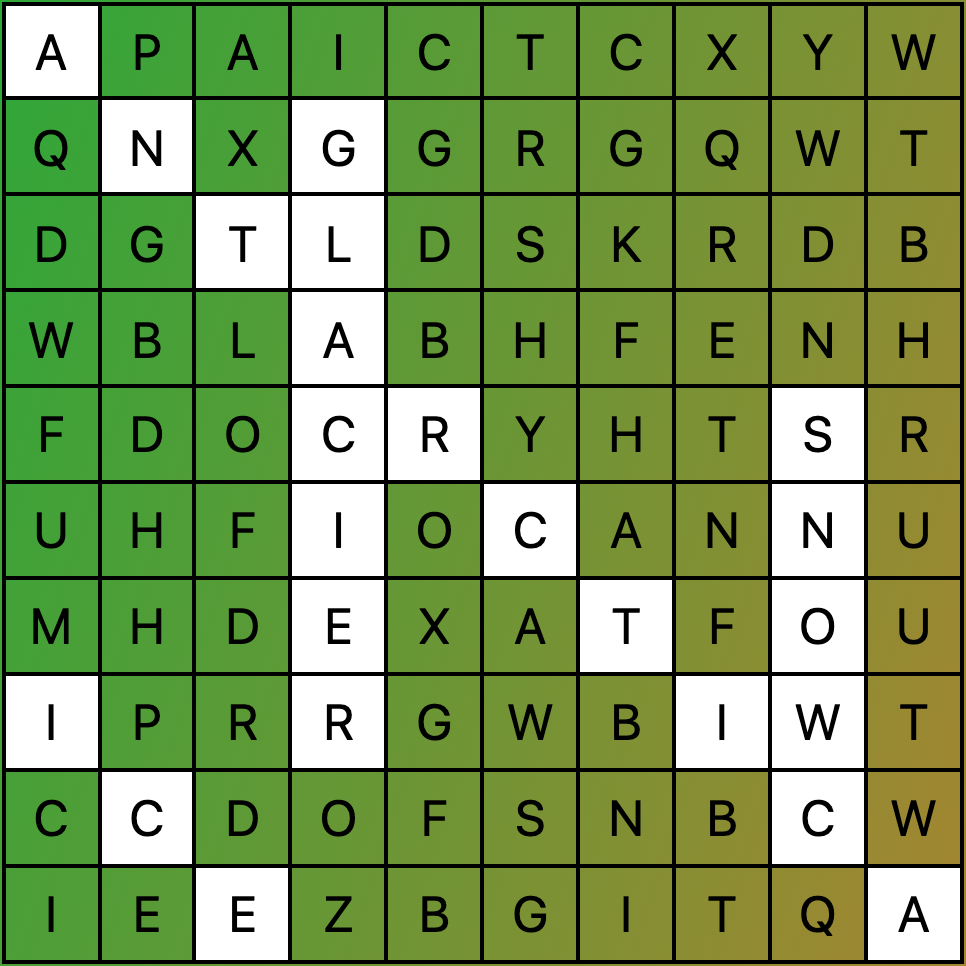
Activity 04.)
nameiro - moraine
rrocie - corrie
ssittraoin - striation
yvlael - valley
Activity 05.) Look at the picture below.
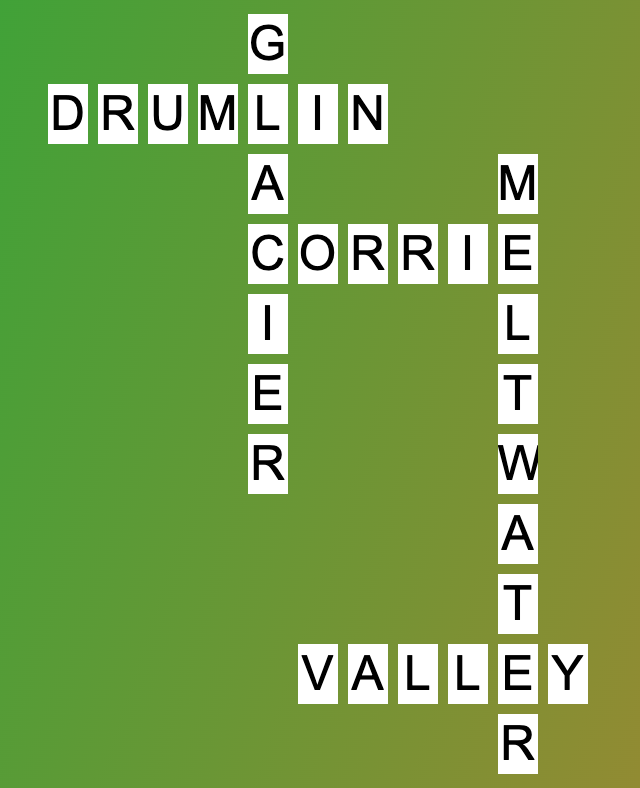
Activity 06.) Buy environment-friendly products, If you use a heat pump or radiator turn it down for a few degrees, etc.
Glossary
A
Abrasion - As plucked stones and rocks are carried along, they scrape the glacier bed. This process is called abrasion.
Arête - When two corries form next to each other, the glaciers erode the rock between them. This forms a ridge called an arête.
Antarctica - A large icy continent which has many glaciers.
C
Crevasse - A deep crack often found in glaciers.
Corrie - A corrie is a glacial landform which is a deep hollow. It often has a lake (tarn) in it.
D
Deposit - To leave or drop things such as rocks and other debris.
Drumlin - A drumlin is a smooth, low hill. It is shaped like an egg and is a clue that a glacier flowed here.
E
Erode - When stones, soil and rocks wear away because of waves, glaciers, rivers, wind, etc.
Erratics - Rocks which were dropped by a glacier which now melted. They are far away from where they came and look out of place. We call them erratics, as in: errors.
F
Freeze thaw weathering - This process makes abrasion easier. Water seeps into cracks in a rock. When it freezes, the ice expands, so the crack in the rock gets bigger. This process repeats until the rock breaks into smaller parts. This process makes plucking easier.
G
Glacier - A glacier is a large mass of snow, ice and debris which flows.
Glacial - Something related to a glacier.
Glaciated - Covered or shaped by glaciers.
Glaciation - The process of being covered by a glacier.
Glacial till - The mixture of debris which the glacier drops off.
Glacial landform - The landform formed by a glacier.
Ground moraine - If the glacier melts, the moraine inside the glacier is exposed. This is called ground moraine.
H
Hanging valley - A small valley which hangs above a larger valley. Each valley was formed by a glacier. The hanging valley was formed by a smaller glacier. When the glacier melted, the hanging valley might have formed a waterfall.
I
Ice age - When the Earth cools to a very cold temperature for a long time.
Ice shelf - Ice attached to a landmass. They are smaller than ice sheets.
Iceberg - Chunks of ice floating in the water.
Ice sheet - A big glacier which covers a large area.
M
Meltwater - Melted ice or snow is called meltwater.
Misfit river - A small river which flows in a U-shaped valley. The river looks tiny and misfit in the U-shaped valley.
Moraine - Moraine is the glacial till dropped by the glacier.
P
Pluck - The glacier plucks stones by freezing around them and then tugging at them.
Pyramidal peak - If four or three corries form around a mountain top, they will cut the mountain walls forming a steep pyramidal peak.
R
Ribbon lake - A long thin lake formed by a glacier eroding more soft rock than hard rock. This leaves a shallow hollow which fills with water.
U
U-shaped valley - U shaped valleys are wide valleys formed by glaciers.
V
V-shaped valley - A small valley formed by a river, which has a V-shape.